
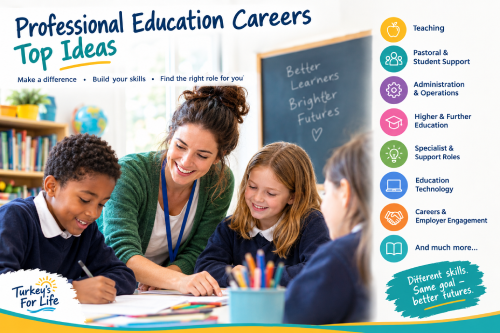
If you are the type of person who likes to help others – whether they be children or adults – the UK education sector offers a wide range of career opportunities for you. People who enjoy working with children, young people, adults or communities.
While teaching is one of the most recognisable education careers, schools, colleges, universities and training organisations rely on many different professionals to support learning and development. And the good news is, lots of roles in education lend themselves well to part time hours and also job sharing.
For some roles, if you are returning to work after a break to start a family, you will be doing term time jobs so this makes life easier for you during the school holidays. Time to spend with your family and also less reliance on alternative childcare arrangements.
This is a two part article with the first one concentrating on types of part time education jobs for those of you who already have previous experience or professional qualifications. In the following article, we will look at different types of part time entry level jobs you could consider in the education sector.
The great thing about education jobs is that their variety means they can suit people with very different skills and interests.
Some roles involve classroom teaching while others focus on administration, pastoral care, special educational needs, careers guidance, technology, research or school leadership.
And it’s not just school-based roles when it comes to education. There are also opportunities to work with learners outside traditional schools, including colleges, universities, adult education centres, nurseries and private training providers.
If you are considering a career in education, understanding the different types of jobs available can help identify the right route to take. Some positions require a university degree and professional qualifications. But there are also others that can be entered through apprenticeships, vocational training or relevant work experience.
Where Can Education Professionals Work?
When we think about careers in education, we might think of schools or colleges and universities. However, there is a variety of settings where you might be employed, depending on your role. Schools are only one part of the UK’s education sector.
Education professionals can also work in:
- Nurseries and early years settings
- Further education colleges
- Universities
- Adult learning centres
- Specialist education settings
- Training providers
- Local authorities
- Charities
- Private education organisations
- Apprenticeship providers
- Education technology companies
- Research organisations
- Examination and awarding organisations
If you are someone who likes to work in different settings, a career in education can offer you this.
What Skills Are Needed For Education Jobs?
Although education careers differ significantly, several skills are useful across the sector.
Communication is essential because most roles will require you to regularly communicate with pupils, students, parents, colleagues and external organisations.
Organisation is also important. Teachers have to plan lessons and assessments while administrators and school leaders may manage complex schedules, records and budgets.
Patience and empathy are valuable when you might be working with pupils and students who have different abilities, personalities, backgrounds and support needs. This could be in teaching roles or other types of support roles.
Adaptability is increasingly important because education careers need you to be able to respond to changes in technology, curriculum requirements, teaching methods and learner expectations.
Teamwork is another important skill. Many roles in education involve collaboration between teachers, support staff, leaders, families and other external professionals.
Digital skills, as you might expect, are also becoming increasingly relevant. Whether teaching roles or alternative careers in education, you will routinely use online learning platforms, communication systems, digital resources and administrative software.
Let’s take a look at some of the main types of education jobs for professionals available across the UK.
Primary School Teacher
Primary school teachers work with children generally aged between four and 11, although the exact age range varies across the UK’s different education systems.
Primary school teachers teach a broad curriculum covering subjects such as Literacy, numeracy, science, history, geography, art and ICT. As a primary teacher, you will most often teach the majority of subjects to the same class for a full school year and this gives you the opportunity to develop strong relationships with pupils and follow their progress across the school year.
The role involves considerably more than delivering lessons. Teachers plan activities, assess pupils’ work, communicate with parents and carers, support children’s wellbeing and adapt lessons for different abilities and learning needs.
If you haven’t already got the qualifications, to be a primary school teacher, you will need Qualified Teacher Status (QTS) in England. Qualification and registration arrangements differ across Scotland, Wales and Northern Ireland.
Secondary School Teacher
If working with older children suits you more then you might want to consider being a secondary school teacher. Secondary school teachers specialise in particular subjects and generally work with pupils aged 11 to 16 – sometimes up to age 18 if the school has an attached Further Education facility.
Common specialisms include mathematics, English, science, modern foreign languages, history, geography, computing, physical education, art and design, music and business studies.
A secondary teacher typically plans lessons, delivers teaching, marks and assesses work, manages classroom behaviour and helps pupils prepare for exams and further education.
There are also opportunities to specialise in areas such as vocational education or work with specific age groups, including sixth-form students.
Secondary teaching can be particularly attractive to those of you who have a strong interest in a particular academic subject and want to share that knowledge with young people.
Early Years Teacher
Early years teachers work with young children before they begin compulsory school education. They usually work in nurseries, pre-schools, children’s centres, early years settings and other childcare environments.
As an early years teacher, your work will involve supporting children’s development through play, structured activities and everyday experiences. It is your job to help children develop communication, social, physical and cognitive skills while also supporting their emotional development.
Early years teachers observe children’s progress, maintain records, communicate with parents and carers and help create safe and stimulating environments.
This can be a rewarding career for those of you who enjoy working with young children and want to contribute to their development during their earliest years.
Special Educational Needs Coordinator
A Special Educational Needs Coordinator, usually known as a SENCO, has responsibility for coordinating SEND provision within a school or educational setting.
As a SENCO, you will work with teachers, support staff, parents and external professionals to identify pupils’ needs and help ensure appropriate support is provided.
Depending on the setting you are working in, your role could also require you to contribute to assessments, develop support strategies, coordinate education plans and work with external agencies such as healthcare and specialist education professionals.
This is a more senior position within the school and it requires significant knowledge of special educational needs and education policy.
Headteacher
Headteachers are responsible for the overall leadership and management of schools. If you have teaching experience and proven leadership skills, this could be a great option for you.
As a headteacher, your responsibilities can include setting the school’s strategic direction, managing staff, overseeing budgets, monitoring educational standards, working with governors and communicating with parents and the wider community.
You would also play an important role in creating the school’s culture and ensuring that pupils receive a high standard of education and support.
Becoming a headteacher usually requires substantial teaching and leadership experience. Many headteachers progress through positions such as subject leader, head of department, deputy headteacher and assistant headteacher.
Deputy and Assistant Headteacher
As the title suggests, deputy and assistant headteachers support the headteacher in running a school.
As a deputy, your responsibilities will vary depending on the size and type of school you are working in but general duties would include curriculum development, safeguarding, behaviour, staff development, assessment, attendance or pastoral care.
In smaller schools, as a deputy head, you could also have your own class to teach, as well, whilst also being responsible for significant areas of school management. On many occasions, you might act as headteacher when the headteacher is unavailable.
Assistant headteachers generally have specific leadership responsibilities and can gain valuable experience that may eventually lead to headship.
Further Education Lecturer
If you prefer working with older students then working ad a further education lecturer could be the best route for you. Again, this is a role that lends itself well to part time working hours.
Further education lecturers teach students who are generally beyond compulsory school age. You might work in colleges, sixth-form colleges or other further education settings.
When it comes to further education, the variety of subjects you could teach opens up. Subjects can range from academic disciplines such as English and mathematics to vocational areas such as construction, engineering, hospitality, business, healthcare and hairdressing. So if you have an expertise in a particular trade or sector, further education could be a pathway for you.
FE lecturers often teach a mixture of theory and practical skills. You will need to assess students, prepare learning materials and help learners progress towards employment, apprenticeships or higher education.
This career can be particularly appealing to those of you with professional or industry experience who want to pass their knowledge on to the next generation.
University Lecturer
University lecturers teach undergraduate and postgraduate students. Depending on your position and the institution where you are based, you might also carry out academic research and contribute to university administration.
As a lecturer, you would typically prepare and deliver lectures and seminars, mark assignments, supervise students and participate in academic activities.
Many university academic careers combine teaching with research. You might publish research papers, attend conferences, secure research funding and collaborate with other institutions.
Academic careers often require postgraduate qualifications, particularly for research-intensive roles.
Careers Adviser
Working as a careers adviser can be a hugely rewarding role; helping young people to make informed decisions about education, training and future employment.
Careers advisors work in a variety of settings such as schools, colleges, universities, local authorities, charities or specialist careers organisations.
In schools, for example, you could be helping pupils to understand the different career options open to them, help them to choose relevant qualifications that match their skills and interests and also apply for apprenticeships or prepare for other employment.
At university level, careers advisers can help students and graduates with job applications, interviews, career planning and employer engagement.
Because you will often be working one to one with young people, strong communication and interpersonal skills are important. Some students might be feeling anxious about future employment and not knowing which path to take so you will need to have empathy skills and also a good understanding of the types of roles out there that would match their skills or interests.
Pastoral Support Worker
Pastoral support workers help school pupils with issues that may affect their education, wellbeing or engagement with school.
They might support pupils experiencing difficulties with attendance, behaviour, relationships, family circumstances or social development. There are lots of circumstances that can have a negative effect on a child’s behaviour, attendance or performance in school.
As a pastoral support worker, your role can involve one-to-one conversations, small-group sessions, communication with parents and collaboration with teachers and other professionals.
Pastoral roles can be particularly important in helping schools provide support beyond academic teaching and you will be front and centre of this.
School Counsellor
Again, this is the type of role that will suit those of you who want to help young people beyond academic studies. School counsellors provide emotional and psychological support to pupils.
As a school counsellor, you will offer a confidential environment where young people can discuss issues affecting them. Safeguarding responsibilities and confidentiality boundaries apply and, obviously, you will need to be aware of those responsibilities and boundaries.
Some of the scenarios you might come across are supporting pupils experiencing anxiety, stress, relationship difficulties, bereavement, family problems or other emotional challenges.
Professional counselling qualifications are normally required for this role.
School Administrator
If you want to work in a school setting but you don’t necessarily want to work directly with pupils then you could put your administrative and organisational skills to excellent use as a school administrator.
Education depends heavily on administrative professionals. School administrators help educational institutions operate efficiently on a day-to-day basis.
As a school administrator, your responsibilities can include maintaining pupil records, answering telephone calls and emails, arranging meetings, managing correspondence and supporting school leaders.
Some administrators specialise in areas such as admissions, attendance, examinations or finance.
These jobs can be a good entry point into the education sector for those of you who enjoy organisation and communication but do not necessarily want to work directly in the classroom.
School Business Manager
If you have a business background, then school business management careers might be a good route for you. School business managers oversee many of the operational aspects of running an educational institution.
There are various responsibilities which can include budgeting, procurement, facilities management, human resources, contracts and financial planning.
In larger schools or academy trusts, business management can be a substantial professional function requiring significant financial and organisational expertise.
People in school business management roles usually come from finance, business administration, human resources or operations backgrounds rather than traditional teaching careers.
Educational Psychologist
A specialist career, educational psychologists use their skills and professional knowledge to support children’s learning, development and wellbeing.
As an educational psychologist, you might assess children’s educational needs, advise schools and families and also recommend strategies to help pupils overcome barriers to learning.
You will usually be travelling around different schools, work with local authorities and / or also other organisations.
School Librarian
School librarians support pupils and staff in accessing books, digital resources and other information.
As a school librarian, your responsibilities can include managing library collections, helping pupils find appropriate reading materials, promoting reading and supporting research and information literacy.
Obviously, we now live in an increasingly digital education environment so you will need to keep your digital skills and knowledge up to date so that you can also pass this on and help students understand how to find, evaluate and use information effectively.
A school librarian career will suit those of you with relevant librarian qualifications and who also enjoy helping young people – and also teaching staff – to find and use information effectively.
School Examinations Officer
School examinations officers are responsible for the administration of examinations within schools and colleges.
Your responsibilities could include
- registering candidates
- organising examination timetables and having contingency plans in place
- managing examination papers
- communicating with awarding organisations
- ensuring the correct examination procedures are followed
- keeping yourself up to date with any changes throughout the school year
- managing and training invigilators and making sure they know what is expected of them
- issuing examination certificates
Although this role might not involve classroom teaching, it is essential to the smooth running of formal assessments and in the support of teaching colleagues and students at what can be a stressful time.
As an exams officer, you need to be highly organised and be able to work accurately, particularly during busy examination periods.
Apprenticeship Adviser or Coordinator
An increasingly important area in the education sector due to Apprenticeships providing an alternative route into employment and qualifications, and an Apprenticeship adviser or coordinator, you will help young people and employers navigate apprenticeship opportunities.
In this role, you might work for schools, colleges, training providers, universities or other education organisations.
You will need extensive knowledge of the many types of Apprenticeships out there which you can then use to advise young people about apprenticeship options open to them.
Another area of your role will be to help young people with their applications and to communicate with employers and support Apprentices during their programmes.
Adult Education Tutor
When we think about careers in the education sector, we often think of small children and teenagers. However, we also know that education is not limited to children and young people.
Adult education provides opportunities for people to gain new skills, qualifications or knowledge later in life.
As an adult education tutors, you can teach subjects such as English, mathematics, languages, computing, vocational skills, arts and crafts and personal development.
There are different environments that you could work in. Foe example, you could be working in schools (doing night school), colleges, adult learning centres, community organisations or facilities offered by private providers.
As with school teaching roles, you will be teaching adults with varying knowledge so you will need to adapt your teaching to your students with different backgrounds, ages and levels of previous education.
Private Tutor
Private tutor careers are great for those of you who want to be flexible with working hours. As a private tutor, you would provide one-to-one or small-group educational support outside mainstream classroom teaching.
Students who use private tutors are often those who need to prepare for GCSEs, A levels, entrance examinations or other qualifications. Sometimes, depending on your specialist areas of expertise, you could also be helping younger children with their SATs preparation at the end of primary school.
As well as exam preparation, you could also specialise in particular subjects or work with students who require additional support.
Tutoring can be undertaken as a full-time career, part-time role or self-employed business which is what makes it an appealing idea for some.
Strong subject knowledge, communication skills and the ability to explain complex ideas clearly are essential. You could be working in your own home, the home of your student or in other areas for small groups.
Education Consultant
Education consultants provide specialist advice to schools, colleges, universities, training organisations or other education-related bodies.
As an education consultant, your work can cover areas such as curriculum development, leadership, teaching quality, technology, safeguarding, inclusion or organisational improvement.
As you might expect, this is a role for those of you who have worked in the education sector for a considerable time.
This can therefore be a potential career progression route if you are an experienced teacher, school leader or other type of education professional.
Education Technology Specialist
If you have strong skills and experience with IT and how it can aid organisations then you could put this to use in the education sector as an education technology consultant.
Technology is increasingly integrated into education, creating jobs for people who combine educational knowledge with digital expertise.
As an education technology specialist your responsibilities can include helping schools and colleges select, implement and use digital learning platforms, classroom technology and educational software.
You could work directly for an educational institution, technology company, training provider or consultancy.
This type of role is particularly relevant at the moment as schools and other organisations seek effective ways to use technology to support teaching and learning.
Designated Safeguarding Lead (DSL)
Safeguarding is a fundamental responsibility within education and schools typically have designated professionals responsible for coordinating safeguarding arrangements.
As a DSL, you will ensure compliance with statutory guidance such as KCSIE (Keeping Children Safe In Education).
A safeguarding lead helps ensure that concerns about pupils’ welfare are identified, recorded and dealt with appropriately so it is a career that carries with it a lot of responsibility.
As a DSL, you would work with a variety of people including staff, parents, social services, local authorities and other relevant agencies when necessary.
Safeguarding roles require strong knowledge of relevant procedures and you will also need excellent judgement skills as well as the ability to handle sensitive information appropriately.
Education Support & Attendance Officer
There are lots of reasons why some children have attendance issues at school and as an education support & attendance officer, it will be your job to get to the bottom of why there might be persistent absence.
In your role as an attendance professional, you would work with schools, pupils and families to address persistent absence and other attendance concerns.
Your work can involve identifying patterns, communicating with families, discussing barriers to attendance and working with other professionals to develop appropriate support so that the family and the child can move forward and improve their attendance and, therefore, their education.
University Student Support Officer
Going to university can be a daunting prospect for some young people as it is often their first time living away from home and being in an unfamiliar environment. For other students, they might just require a few tips or advice about their student life.
Universities employ student support officers who are dedicated to supporting students throughout their studies. If you like to help young people, this type of ripple could be ideal for you.
You will provide advice on a variety of areas such as academic processes, wellbeing services, disability support, accommodation, finances or other aspects of university life.
Specific responsibilities will vary significantly depending on the institution employing you.
Education Recruitment & Employer Engagement Roles
Different education organisations also employ people who connect students with employers and employment opportunities.
These roles have various titles such as:
- employer engagement officers
- placement coordinators
- work experience coordinators
- education recruitment professionals
In this type of role, your work would involve building relationships with businesses, arranging work placements for students, organising careers events and helping students understand the various employment opportunities available to them.
These positions can be particularly relevant in further education and higher education where employability and links with industry are often important parts of the student experience.
Choosing The Right Education Career
The right education career depends largely on what type of work you enjoy and where your skills and qualities are best suited.
If you enjoy explaining subjects and working directly with children or adults then you might find teaching to be an attractive career path. If you prefer supporting people directly, on the other hand, why not consider pastoral or student support roles.
If you are considering an education career, you will need to check the requirements for the specific role and nation of the UK in which you intend to work. Education systems and professional requirements are not identical across England, Scotland, Wales and Northern Ireland.
And if you are looking to start a career in education but you need to know the entry level options that are available to you, make sure to check out our follow up article, coming soon.