
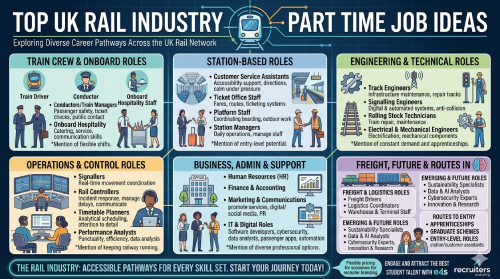
There are lots of stories out there of people who dreamed of being a train driver when they grew up. And some of those people achieved their dreams. If you are someone who loves trains and all things rail travel, have you ever thought about doing a part time job that indulges your passion in the rail industry?
Yes, there are train driver jobs to be had but there are also so many other roles out there that will give you the opportunity to be a part of the UK’s rail network.
The UK rail industry is one of the most complex and diverse employment sectors in the country. Supporting millions of passenger journeys and vast amounts of freight movement every year, it relies on a wide range of professionals working both on the front line and behind the scenes.
While many people associate rail careers with train driving, the reality is far broader and you could work in roles that involve engineering, operations, customer service, business support and also the increasingly growing number of digital roles.
Tempted? Let’s have a look at some of the main types of jobs in rail across the UK, highlighting their responsibilities, the skills required and also the roles’ importance within the wider transport system.
Train Crew & Onboard Roles
These are perhaps the types of roles that automatically spring to mind when it comes to working in the rail industry. Most of these roles are for those of you who want to be face to face with the general public, helping passengers to have a smooth train ride.
One of the most visible categories of jobs in rail is train crew, which includes train drivers, conductors and onboard staff.
Train Drivers
The job for those of you who want to be at the helm! Train drivers are responsible for operating trains safely and efficiently, ensuring adherence to timetables, speed limits and signalling systems.
Being a train driver requires intense concentration, strong decision-making skills and the ability to remain calm under pressure. Before becoming a train driver, you will undergo extensive training and also pass strict medical and psychological assessments.
Train driving is often seen as a prestigious role within the industry due to its high level of responsibility and relatively strong salary progression. However, it also involves shift work, including nights, weekends and holidays so you will need to be able to work flexible hours.
If you love to drive but you think train driver jobs might not be for you, check out our other part time job ideas for drivers.
Conductors & Train Managers
Conductors (or train managers) play a key role in passenger safety and service.
As a conductor, you will be respınsible for checking tickets, assisting passengers, making announcements and handling any onboard issues.
You will also act as the main point of contact between passengers and the train operator.
A switch train driver jobs, conductors and train managers also need to be able to do shift work that includes evenings and weekends. Jobs might be on local regional trains or on long distance services, travelling all around the UK.
Onboard Hospitality Staff
On some services, particularly long-distance routes, onboard staff provide catering and customer service. This type of role would suit those of you who have a passion for the hospitality industry as well as rail.
As you might imagine, you will need to have excellent communication and customer service skills.
Train operating companies across the UK employ thousands of people in these roles and this could be a great option for those of you looking for entry level jobs within the rail industry.
Station-Based Roles
If you want to do part time rail industry jobs but you do not want to be actually on the train then there are a variety of roles you could do in the railway station. Railway stations are complex environments requiring a variety of staff to ensure smooth operations.
Customer Service Assistants
As a customer service assistant, you will help passengers with ticket purchases, directions, accessibility support and general enquiries.
You will likely be the face of the railway and will play a crucial role in shaping public perception of the service. This could be a hugely rewarding job but when there are train delays and cancellations, you will need to be able to keep calm under pressure and sometimes deal with unhappy passengers.
Ticket Office Staff
Ticket offices are increasingly automated but there are still some rail companies who will employ staff to handle ticket sales, refunds and travel advice.
This role will require you to have strong knowledge of fares – including any deals at particular times of day, routes and ticketing systems.
Platform Staff
Platform staff ensure trains depart safely by coordinating boarding, monitoring passenger flow and communicating with drivers.
Obviously, part time jobs as platform staff will see you working outdoors for much of the time so bare in mind, this will also include cold and wet winter days. This is definitely a role for people who love to work outdoors. If this is you, be sure to take a look at our other ideas for working outdoors.
Station Managers
Station managers oversee daily operations, manage staff and ensure safety and performance standards are met. This role requires leadership, organisational skills and a strong understanding of railway operations.
Station-based roles are often entry level roles and these can be a great way for you to start to build a career within the rail industry, progressing to management or operational careers.
Engineering & Technical Roles
As yoıu might expect, engineering is one of the largest and most critical areas of employment in rail.
The UK rail network requires constant maintenance, upgrades and expansion, and this means there is a constant demand for skilled engineers.
Although engineers are highly skilled, with relevant qualifications, there could also be openings in entry level jobs where you can train on the job by way of Apprenticeships or other routes so that you can gain recognised qualifications.
Again, many of the engineering and technical roles will require a lot of outdoor work and also flexibility for hours of work, including evening and weekend work.
Track Engineers & Maintenance Workers
These professionals maintain the railway infrastructure, including rails, sleepers and ballast. They inspect tracks, repair faults and ensure safe conditions for train operations.
Signalling Engineers
Signalling systems control train movements and prevent collisions. Engineers in this field design, install and maintain these systems which are increasingly digital and automated.
Rolling Stock Technicians
Rolling stock refers to the trains themselves. Technicians are responsible for maintaining and repairing trains, ensuring they are safe and reliable for service.
Electrical & Mechanical Engineers
These specialists work on electrification systems, power supply and mechanical components of trains and infrastructure.
Engineering roles require strong technical skills and safety awareness.
Operations & Control Roles
Behind every train journey is a network of professionals coordinating operations in real time. Could you be part of a team of people who work to make sure everything runs smoothly?
Here are some of the types of rail industry jobs within Operations & Control.
Signallers
Signallers control train movements across the network using signalling systems.
They ensure trains run safely and efficiently, making decisions in response to delays or disruptions.
Rail Controllers
Rail controllers oversee the entire network or specific routes, coordinating responses to incidents, delays and operational challenges.
In this role you will work in control centres and communicate with drivers, station staff and engineers. As you might expect, you will need to be able to work calmly when under pressure and make decisions quickly so that any disruption is kept to a minimum.
Timetable Planners
If you have got excellent attention to detail and you love to plan, this coıld be the perfect role for you.
Timetable planners design train schedules, balancing passenger demand, infrastructure capacity and operational constraints.
This is a highly analytical role requiring strong problem-solving skills.
Performance Analysts
Performance teams monitor punctuality, delays and service reliability. They analyse data to improve efficiency and customer satisfaction.
Operations roles are critical to keeping the railway running smoothly and require a combination of technical knowledge and decision-making ability. If this is you, these could be the perfect types of jobs for you.
Construction & Infrastructure Roles
From entry level roles to those requiring professional qualifications, the rail industry is constantly evolving and major infrastructure projects create thousands of jobs around the UK.
Civil Engineers
Civil engineers design and oversee the construction of railway infrastructure such as bridges, tunnels, tracks, retaining walls and stations.
Civil engineers are also increasingly involved in the implementation of sustainable green technology solutions.
Surveyors
Surveyors assess land and infrastructure to support construction and maintenance projects. They also assess surrounding land to make sure it is safe to handle any new infrastructure.
Project Managers
Project managers coordinate large-scale rail projects, ensuring they are delivered on time and within budget. Naturally, excellent organisational skills are necessary for project management roles within any sector.
Major projects such as new rail lines or station redevelopments can create thousands of jobs across construction and engineering disciplines.
Business, Administrative & Support Roles
Working within the rail industry is not all about being out there on the trains, tracks and stations. There is a whole host of other roles that you can do within the sector – some of which lend themselves to working part time.
Within the rail industry, there is, of course, a wide range of business functions.
Human Resources (HR)
HR professionals manage recruitment, training and employee wellbeing. There couıld also be entry level positions in this area where you can start to work towards professional HR qualifications in the future.
Finance & Accounting
Finance teams handle budgeting, investment and financial planning for rail organisations. If this is your strength or your background, there are often roles within the rail industry.
Marketing & Communications
These types of roles within the rail industry can be both rewarding and challenging at the same time.
These teams promote rail services, manage public relations and communicate with passengers using both digital methods, such as social media, and more traditional methods such as information boards and posters.
If brand management is your thing and you have a passion for all things rail, these types of part time raşk jobs could be right up your street.
IT & Digital Roles
As rail systems become more technologically advanced and automated, there is growing demand for IT professionals, including software developers, cybersecurity specialists and data analysts.
Other IT and digital roles include those that are centred around passenger experience such as contactless ticketing, apps and passenger information systems.
Predictive maintenance systems, driverless trains, IT project management…there are numerous roles within the rail industry for those with experience in the IT and digital areas.
Freight & Logistics Roles
Rail is a key part of the UK’s logistics network, transporting goods across the country. We have written a detailed article providing ideas for different warehouse and logistics part time jobs you can do if the rail industry is not your thing.
But if you do want to work within the rail industry and you have a background in freight and logistics or you are looking for entry level roles, here is a few ideas of the types of jobs you could do.
Freight Train Drivers
Similar to passenger train drivers, freight drivers transport goods rather than passengers, often working long-distance routes.
Freight trains transport variıus goods including consumer retail goods, construction materials, industrial materials, waste materials and hazardous materials such as chemicals and petroleum.
Logistics Coordinators
These professionals plan and manage the movement of goods, ensuring efficient and timely delivery.
Warehouse & Terminal Staff
As with haulage companies, freight rail terminals require staff to load, unload and manage cargo. As you might expect, part time jobs in this area will require a certain level of physical fitness and you will need to be able to work flexible shifts.
Freight roles are essential to the UK economy, supporting industries such as manufacturing, retail and construction.
Apprenticeships, Graduate & Entry-Level Roles
The rail industry offers numerous entry routes for young people and career changers. So if you’re looking to change direction in your career, the huge changes taking place inside the rail industry could offer you an opportunity to land a role with training included.
Apprenticeships
Apprenticeships allow you to earn while you learn, gaining practical skills in areas such as engineering, operations and business administration.
You will work towards nationally recognised qualifications that you can use to develop your career in your chosen field and, depending on the field you are working in, some of these qualifications can take you to degree level and beyond.
Graduate Schemes
Many rail organisations offer structured graduate programmes in engineering, management and other disciplines such as IT.
Entry Level Roles
The great thing about part time rail industry jobs is there is lots of scope for entry level roles. A perfect opportunity to get a foot in the door and gain some valuable work experience.
Positions such as station assistants or customer service staff could be a good starting point if you are new to the industry.
Recent initiatives in the UK have aimed to expand access to rail careers, offering thousands of Apprenticeships across a wide range of roles, from engineering to IT and customer service.
Emerging & Future Roles in Rail
As with other industries, as the rail industry modernises and adapts in an increasingly fast moving world, new types of jobs are emerging. This means more opportunity for those of you with particular skills.
Sustainability Specialists
With a focus on reducing carbon emissions, rail companies are investing in greener technologies and practices. If this is your background, rail industry jobs could prove to be hugely rewarding.
Data Analysts & AI Specialists
Digital transformation is creating demand for professionals who can analyse data and improve operational efficiency. Knowledge of AI is very much an in demand skill across all sectors, these days.
Cybersecurity Experts
As rail systems become more connected, protecting them from cyber threats is increasingly important. This is about protecting passengers and their details, right up to making sure trains are running efficiently and safely.
Innovation & Research Roles
Companies are developing new technologies, such as battery-powered trains and advanced signalling systems, creating opportunities in research and development within these areas
Working In The UK Rail Industry
The UK rail industry offers a vast range of career opportunities, far beyond the commonly perceived roles of train drivers and station staff. From engineering and operations to customer service and business support, the sector requires a diverse workforce with a wide range of skills. From entry level roles to those where professional qualifications and skills are needed.
One of the key strengths of the rail industry is its accessibility – it can be a great sector to research for part time jobs and careers. Whether you are entering through an apprenticeship, transitioning from another career or joining as a graduate, there are multiple pathways into the sector. Additionally, the ongoing need for maintenance, upgrades and innovation ensures a steady demand for skilled workers.
If you’re considering a career in rail, the most important step is to understand where your strengths lie. If you enjoy hands-on work and problem-solving, engineering may suit you. If you prefer working with people, customer-facing roles could be a better fit. And if you have analytical or technical skills, there are growing opportunities in operations and digital roles.
If you are looking for part time jobs and you think the rail industry could be the sector for you, take a look to see if there are any current opportunities either in the rail industry or in other fields that you might be interested in. Click here to find a part time job.