
In a previous article, we introduced the STAR interview method and explained that employers are increasingly placing greater emphasis on this type of behavioural interviewing. Whatever type of part time jobs you are applying for – from management positions to entry level roles – chances are you’ll encounter STAR method interview questions.
This is good news for you because the STAR method is one of the most effective ways to answer competency-based interview questions. It enables you to provide clear, structured examples from your previous experience. And, if you have no previous work experience, you still get the opportunity to draw on other life experiences to give the interviewer an idea of your traits and skills and how you might fit into the company set up.
This guide explores the 20 most common STAR interview questions that are asked by UK employers and explains what interviewers are looking for in your answers.
What is the STAR Method?
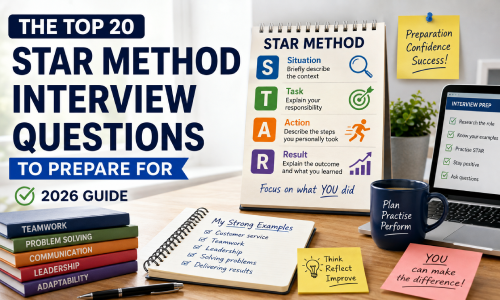
Just to recap – STAR stands for:
- Situation – Briefly describe the context
- Task – Explain your responsibility or objective
- Action – Describe the steps you personally took
- Result – Explain the outcome and what you learned
The key to a successful STAR answer is keeping each section balanced. Many candidates spend too much time describing the situation and not enough explaining their own actions.
Recruiters want to know what YOU did, not what your team or others in your group did. This is your time to sell yourself.
Scenario 1: Tell me about a time you dealt with a difficult customer
This is perhaps the most common competency question in UK interviews.
Interviewers assess whether you are showing:
- Communication skills
- Patience
- Emotional intelligence
- Customer service skills
- Problem-solving
A strong answer should demonstrate how you remained calm, listened carefully, resolved the issue professionally and achieved a positive outcome.
Even if you have not got any previous customer service experience, plan some answers around examples from projects you have been a part of, any volunteering you might have done or sports teams you are – or have been – a part of.
Scenario 2: Describe a time when you worked successfully as part of a team
Almost every role in the workplace requires teamwork.
Your interviewer will want evidence that you can:
- Collaborate with others
- Respect different opinions within the team
- Contribute fairly
- Resolve disagreements
- Support colleagues
Avoid saying, “We did…”
Instead explain: “I contributed by…”
Remember, your interviewer wants to understand your personal contribution. And this type of question is perfect for those of you with little or no experience. There are lots of aspects of our daily life, outside of the workplace, where working together as part of a team is necessary.
Scenario 3. Tell me about a time you had to solve a difficult problem
Problem solving is one of the UK’s most desirable employability skills.
When you are being interviewed, the interviewer is looking to see whether you can:
- Gather information
- Analyse options
- Make decisions
- Stay calm under pressure
- Deliver practical solutions
You could use examples such as a time when you might have had a to:
- Improve a process
- Solve a customer complaint
- Fix a technical issue
- Manage unexpected project challenges
Again, if you haven’t got work experience to draw from, we have all had times in our lives when we have faced challenges. How did YOU tackle this challenge and come up with a solution to the problem?
Scenario 4. Describe a time when you had to work under pressure
Pressure is inevitable across all industries and sectors so you need to be able to show that you can handle that pressure.
Interviewers assess your ability to:
- Prioritise work
- Stay organised
- Meet deadlines
- Maintain quality
- Manage stress
Strong answers often involve busy periods, urgent projects or competing priorities. If you have been a student, for example, there will have been times where you will have needed to work under pressure to keep up with deadlines on assignments.
Scenario 5. Give an example of a time you showed leadership
Leadership questions aren’t just for managers. So even if you are going for an interview for an entry level part time job, have an answer prepared about when you displayed your leadership qualities.
Leadership can include:
- Organising a university project
- Leading volunteers
- Mentoring new staff
- Taking ownership of a difficult task
- Motivating colleagues
For this type of question, the person interviewing you will be looking for how you showed initiative in certain situations rather than a job title you might have held previously.
Scenario 6. Tell me about a time you made a mistake
Everyone makes mistakes – nobody is perfect.
Interviewers aren’t looking for perfection. They are looking for how you handled the mistake that you made.
They’re assessing:
- Accountability
- Honesty
- Learning ability
- Professional maturity
Think about a mistake that you have made either in the workplace or elsewhere and explain how you corrected it and describe what you learned from it.
Whilst you might feel you need to impress your interviewer, avoid saying you’ve never made a mistake.
Scenario 7. Describe a time you had to adapt to change
Whatever type of part time job you are applying for, the workplace will be constantly evolving. And that means you will need to be able to evolve with it.
Demonstrating you can adapt to change gives the interviewer confidence in you for when the company might introduce:
- New technology
- New systems
- New managers
- New processes
- Organisational restructuring
Whatever scenario you choose for this answer, make sure you show that you embraced change rather than resisting it.
Scenario 8. Tell me about a conflict you experienced at work
Conflict questions measure emotional intelligence and, again, don’t worry if you haven’t got an example from a previous job. Think of conflict you faced in other areas of your life.
Recruiters who ask this question are looking for someone who can:
- Listen objectively
- Stay calm
- Communicate respectfully
- Find practical solutions
- Maintain professional relationships
Avoid examples involving major personal disputes that you might have had with friends and think about professional disagreements that were resolved positively. This could be an example from a sports team you are a member of or a volunteer group.
Scenario 9. Describe a time you managed multiple priorities
How are your multitasking skills? Time management is essential across nearly every profession.
Interviewers are looking for evidence that you can:
- Prioritise tasks
- Plan effectively
- Meet deadlines
- Stay organised
- Deliver quality work
Try to think of concrete examples such as balancing studies with part-time work, managing several clients at once or coordinating multiple projects.
Scenario 10. Tell me about a time you exceeded expectations
Have you ever gone above and beyond – or at least done more than the minimum that was expected of you? Employers love candidates who go beyond the minimum.
When this question is asked, the interviewer is looking for evidence of you:
- Showing initiative
- Demonstrating motivation
- Having good customer focus
- Showing commitment to your role
- Taking pride in your work
If possible, try to come up with examples such as a time when you:
- Improved efficiency
- Increased sales
- Helped colleagues
- Delivered a project ahead of schedule – this could also include school or university projects
- Received excellent customer feedback – or excellent feedback from a teacher, lecturer or a volunteer leader
And, where possible, include measurable results.
Scenario 11. Describe a time when you had to persuade someone
Persuasion skills matter in far more roles than just sales. Sometimes, in a workplace, you might need to persuade team members to take on tasks they are reluctant to do, for example. You will need to convince them that your idea is worth taking onboard.
Your interviewer will assess your ability to:
- Influence decisions
- Build trust
- Present logical arguments
- Understand different perspectives
Scenario 12. Tell me about a time you demonstrated initiative
Employers appreciate people who don’t wait to be told what to do. They want you to be able to work under your own initiative and take some responsibility on your own shoulders.
Have there been any times whether in the workplace or elsewhere where you have been able to:
- Identify inefficiencies
- Suggest improvements
- Start new projects
- Volunteer for extra responsibilities
- Learn new skills independently
Showing initiative can help to distinguish you from the competition and land you that dream part time job.
Scenario 13. Describe a time you received constructive criticism
Feedback is part of every career and constructive criticism is very different to being criticised in a nasty way. Constructive criticism is that which is designed to help you and encourage you to grow in your role.
When the interviews asks this question, they are looking for evidence that you can:
- Accept feedback professionally
- Reflect on that feedback
- Improve performance
- Continue developing
Choose examples where you received feedback from someone and this helped you to improve.
Scenario 14. Tell me about a goal you achieved
Goal-setting demonstrates ambition and planning so think back to any goals you have set yourself in the past and what you did to achieve those goals.
They can be academic or workplace goals but they can also be goals you have set yourself in life – outdoor and sporting goals, for example.
Giving examples of this shows your interviewer that you can display:
- Motivation
- Determination
- Planning
- Persistence
Good examples you could include are:
- Completing qualifications
- Hitting sales targets
- Improving productivity
- Delivering successful projects
- Learning new software
- Sporting goals like completing a running event or climbing a mountain
Explain both the process you went through to get there and what the outcome was.
Scenario 15. Describe a time when something didn’t go according to plan
Recruiters know projects don’t always run smoothly so they will be looking for you to be able to explain both what happened and, more importantly, how you dealt with that challenge.
They want to see resilience.
Explain:
- What went wrong
- How you responded
- What changes you made
- The final outcome
Scenario 16. Tell me about a time you improved a process
Answering this type of question could really impress interviewers because they are always looking for ways that their business practices could be improved or streamlined.
Again, there could be times when you have improved a process outside of the workplace to make something work more efficiently for yourself.
Try to think of examples such as:
- Streamlining paperwork
- Automating repetitive tasks
- Improving communication
- Reducing errors
- Saving time or money
Where possible, quantify the improvements by giving figures such as:
- Reduced processing time by 30 per cent
- Saved five hours per week
- Increased customer satisfaction by cutting queueing time by 1 minute
Scenario 17. Describe a time you delivered excellent customer service
Customer service questions are not reserved simply for those of you applying for part time jobs in the retail sector. Businesses across many sectors need to rely on staff providing strong customer service skills.
Potential employers will be looking for:
- Professionalism
- Communication
- Empathy
- Ownership
- Relationship-building
Think beyond simply solving a complaint and try to explain how you created a positive customer experience – both for individuals and generally.
Scenario 18. Tell me about a time you had to learn something quickly
Today’s workplace changes rapidly and potential employers will be looking for staff who are willing to continuously develop to stay on top of developments and use them to drive the company forward.
Examples of learning something quickly could include:
- Learning new software
- Adapting to new systems
- Covering another role during an absence
- Completing urgent training
- Picking up technical knowledge necessary to complete a task or a project
Showing an enthusiasm for learning can help you to stand out in an interview.
Scenario 19. Describe a time you motivated others
If you are working in management or a leadership role then you will need to be able to motivate others. But motivation isn’t just limited to management roles.
Try to think of examples such as:
- Encouraging teammates – both in an out of the workplace
- Supporting struggling colleagues
- Organising group activities
- Maintaining morale during busy periods
Interviewers will be looking for you to be a positive influence rather than someone commanding authority. And this is a great question for those of you with little or no work experience because there are lots of non-workplace scenarios where you might have motivated someone.
Scenario 20. Tell me about a time you had to work with someone whose working style was very different from yours
It can be very easy to think your way of working is the same as everyone else’s – or that your way is the only way. But these days, many companies value diversity of thought and collaboration between people with different personalities, backgrounds and approaches.
When you are asked this question, interviewers are assessing your ability to:
- Adapt your communication
- Show respect for different viewpoints
- Build productive relationships
- Resolve misunderstandings
- Work towards shared goals
Avoid criticising the other person and focus on how you adapted your own approach to achieve a successful outcome.
Tips for Preparing STAR Answers
Preparation is the difference between average and exceptional interviews. Rather than memorising scripts, build a bank of versatile examples that demonstrate different competencies.
Aim to prepare between 8 and 10 strong examples covering areas such as leadership, teamwork, communication, problem-solving, conflict resolution, customer service, adaptability, resilience and achieving results.
And don’t forget, you will find that many examples can be adapted to answer several different questions.
When you are practising:
- Keep answers between 1½ and 3 minutes long
- Focus on YOUR individual contribution
- Include measurable outcomes wherever possible
- End with what you learned or how the experience improved your skills
- Practise aloud so your delivery sounds natural rather than rehearsed. Ask a friend or family member to ask you the questions so that you can practice for different scenarios. Whatever type of part time job you are applying for, you can tailor your answers to that particular role.
Preparing for a wide range of competency-based questions is one of the most effective ways to succeed in your part time job interviews. While no two interviews are identical, these STAR method interview questions cover many of the core competencies that employers consistently assess.
Rather than memorising 20 separate answers, prepare a portfolio of examples from your work, education, volunteering experience or other areas of your life. A single strong example can often be adapted to answer several different questions. With thorough preparation and confidence in your examples, you will be well equipped to impress interviewers and maximise your chances of securing your next part time role.