
Are you applying for part time jobs and getting all the way through the application process but finding that you fall at the final hurdle – the interview stage?
For many of you, job interviews can be one of the most nerve-racking parts of the recruitment process and you might feel unable to let your true personality shine through.
While your CV and any other parts of the process may have secured your interview, it is your ability to demonstrate your skills, experience and personality that will determine whether or not you receive that job offer.
In the UK, competency-based interviews have become the standard across many industries, including areas like retail, hospitality, finance, engineering, healthcare and the public sector.
And the good news is, there is a structured method out there to help you get through these types of interviews. One of the most effective ways to answer competency-based interview questions is by using the STAR method.
This structured technique helps you to stay focused and provide clear, relevant and persuasive answers that showcase your abilities with real-life examples.
Whether you’re applying for your first part time job, an apprenticeship, graduate scheme or a senior management role, mastering the STAR method can dramatically improve your interview performance and give you a much better chance at landing the role you really want.
What Is the STAR Method?
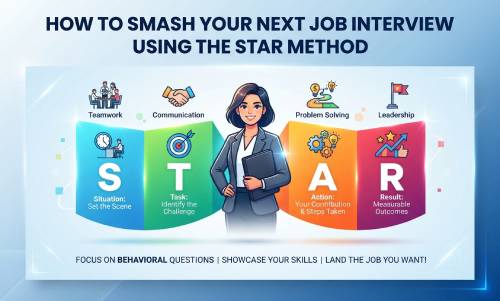
STAR is an acronym that stands for:
- Situation
- Task
- Action
- Result
Rather than you trying to think on your feet in interviews with the result of giving vague or theoretical answers, the STAR method encourages you to explain a real example from your own experience.
This allows interviewers to understand not only what you have done but also how you approach challenges and achieve results.
Let’s break down each stage…
Situation
Start by briefly explaining the background. Set the scene by describing where you were working or studying and what was happening.
Keep this section of your answer concise. You will often need just a few sentences.
For example, if you had a part time seasonal job in the past, you could draw on a situation from your time in that role:
“While working as a customer service assistant during the Christmas shopping period, our store experienced unusually high customer volumes.”
Task
Next, you can go on to explain the responsibility or challenge that you faced.
This should clearly identify what needed to be achieved.
For example:
“I was responsible for managing customer complaints while helping to reduce queue times.”
Action
This is the most important part of your answer.
Explain exactly what you did. This is not about what the team did. Interviewers want to understand what your contribution was: your decision making and your practical skills.
You can include specific actions such as:
- Communicating with customers
- Organising workloads
- Solving problems
- Prioritising tasks
- Working under pressure
- Supporting colleagues
- Taking initiative
For example:
“I took the initiative and came up with a simple system, directing customers with quick enquiries to available staff while personally resolving more complex complaints. I also kept customers informed about waiting times and regularly updated my manager on queue lengths.”
Result
Now you can round this off by explaining the outcome of your actions.
Where possible, include measurable achievements.
For example, you can include measurable targets such as:
- Improved customer satisfaction
- Increased sales
- Reduced errors
- Saved time
- Completed projects early
- Received positive feedback
- Achieved targets
You could say something like:
“Customer complaints reduced during the busiest periods, waiting times improved and my manager recognised my approach during our monthly team meeting.”
It is good to always finish on a positive note that demonstrates your success with the challenge you faced and how you faced it.
Why Employers Like The STAR Method
Many UK employers use competency-based interviews because past behaviour is considered to be one of the best predictors of future performance. The interviewer gets to focus on concrete evidence and you are given the opportunity to showcase your skills.
So, rather than asking abstract questions like, “Are you good at teamwork,” your interviewer will ask questions in the following ways:
- Tell me about a time you worked successfully in a team
- Describe a situation where you dealt with conflict
- Give an example of when you solved a difficult problem
Using STAR allows you to answer these questions in a logical, professional way and you also get the opportunity to showcase your soft skills as well as any professional qualifications you might have.
Interviewers appreciate STAR because it:
- Helps you to keep your answers focused
- Demonstrates your genuine experience
- Makes examples easy to follow
- Provides evidence rather than opinions
- Shows self-awareness
- Highlights measurable achievements
Common UK Competency Interview Questions
The good news about competence interview questions is that many employers ask similar ones to each other.
This gives you the perfect opportunity to prepare ahead of time the type of answers you can give. Choose your best examples for each question.
Here are some of the types of scenarios you can expect your interviewer to put to you:
Teamwork
- Tell me about a time you worked as part of a successful team
- Describe a team project you are proud of
Communication
- Tell me about a difficult conversation you handled
- Give an example of explaining something complicated
Problem Solving
- Describe a difficult problem you solved
- Tell me about a challenge that required creative thinking
Leadership
- Tell me about a time you led others
- Describe when you motivated a team
Time Management
- Give an example of juggling competing priorities
- Tell me about meeting a tight deadline
Customer Service
- Describe a difficult customer interaction
- Tell me about exceeding customer expectations
Adaptability
- Tell me about dealing with unexpected change
- Describe learning a new skill quickly
Conflict Resolution
- Tell me about resolving a disagreement at work
- Describe managing conflict between colleagues
Choosing the Right STAR Examples
One mistake candidates make is, when asked to provide these examples, they use the first example that comes to mind.
Instead, as we said above, now you know the types of scenarios you could be faced with, prepare six to eight strong stories before you go to your interview.
Make sure your stories incorporate examples such as:
- Solving problems
- Improving processes
- Working under pressure
- Supporting customers
- Handling conflict
- Taking initiative
- Meeting deadlines
- Learning quickly
- Delivering measurable results
And, of course, the same story can be used to answer several different questions if you adjust the emphasis.
For example, if you are using a story such as organising a successful charity event in your local community, you can demonstrate how you showed excellent:
- Teamwork
- Leadership
- Planning
- Communication
- Problem solving
- Time management
Focus on Your Actions
Remember, when you are in your interview, the interviewer is looking for you to give examples of what you can DO. Make sure you don’t spend too much time describing the situation and setting the scene.
Interviewers are far more interested in your actions so make sure you have specific examples to give. Step-by-step where relevant, so that you are highlighting your own personal contribution rather than vague, “we worked as a team to get everything finished.”
Use Real Results
Results don’t always have to involve huge financial savings for a company you worked for. You might be able to give examples of results from that charity event you organised or some other volunteer work you did in your community.
Real results can include examples such as:
- Completing work ahead of schedule – what was the original schedule and by how long did you beat this?
- Receiving positive customer feedback – can you give any examples?
- Improving efficiency – give previous figures and new figures.
- Reducing complaints – by how many? Can you give a percentage?
- Building stronger relationships with customers or with a team you worked with
- Helping colleagues – what did you do to help?
- Learning valuable skills – what were those skills? Be specific.
- Increasing confidence – what is the before and after version of you?
- Meeting performance targets – what were those targets?
Keep Answers Concise
If you are someone who tends to find yourself waffling and losing your thread in interviews (nerves can do this) the STAR method can help to keep you in check and focused and prevent rambling.
Aim for answers lasting between one and three minutes. Again, you can practice this before you go for your interview – but make sure most of your answer is spent describing your actions.
Use Examples From Different Areas of Life
The days of employers looking purely at your qualifications and your previous work experience are over.
So if you have limited (or no) work experience, don’t worry about it too much. Lots of us have done things in our everyday lives, out of the workplace, where we have taken actions and achieved positive results.
When you are thinking about what scenarios you can describe in your interviews, make notes of positive outcomes from places like:
- School
- College
- University
- Volunteering
- Sports teams
- Clubs and societies
- Part-time jobs
- Work experience
- Caring responsibilities
- Personal projects
What matters is demonstrating relevant behaviours – and they do not need to be examples from the workplace if you haven’t got any.
Practise Without Memorising
Preparing STAR examples is essential, but avoid memorising word-for-word scripts.
Interviewers may ask follow-up questions so you need to understand your examples rather than recite them. The interviewer doesn’t want to listen to a robot recital. Make sure you listen to the question and then answer it naturally so that your personality – as well as your skills – shines through.
This creates more natural conversations with everyone in the room.
Tailor Your STAR Answers To The Job
Just as you would tailor any cover letter or application form to the part time job you are applying for, before you go for your interview, carefully read the job description of the job you applied for to remind yourself of the key points.
Identify the key skills the employer is looking for in the job description.
Look our for keywords such as:
- Teamwork
- Organisation
- Customer service
- Leadership
- Communication
- Initiative
- Accuracy
- Flexibility
When you have identified these, choose STAR examples that demonstrate those exact qualities.
For example, if you are applying for a customer service role, ensure customers feature prominently in your answers.
If you are applying for a project management position, prioritise examples showing planning, coordination and organisation.
Preparing Before The Interview
Before you go to your interview, make yourself a STAR method checklist related to the job description – what the description is asking for and the concrete examples you can provide to demonstrate you are the person they are looking for.
A simple preparation strategy can make a huge difference. Keep it concise so that you can remember your stories.
Here are some examples. If the job description highlights:
- Teamwork: You worked on a university group project
- Leadership: You managed weekend retail shifts
- Problem solving: You successfully resolved a customer complaint
- Communication: You delivered presentations
- Adaptability: You learned how to use new software quickly
- Time management: You balanced work and study
Example STAR Method Answer
Let’s take a look at a scenario put to you by the interviewer and then look at how best to answer it using the STAR method.
The interviewer says, “Tell me about a time you have had to deal with a difficult customer.”
Situation
While working in a busy café, a customer became frustrated after receiving the wrong order during the lunchtime rush.
Task
My responsibility was to resolve the issue quickly while maintaining good customer service and preventing delays for other customers.
Action
I apologised sincerely, listened carefully to the customer’s concerns and immediately arranged for the correct meal to be prepared.
While they waited, I offered a complimentary drink and kept them updated on progress.
I also spoke with the kitchen team to identify how the mistake occurred so we could avoid similar issues later in the day.
Result
The customer thanked me for resolving the issue professionally and left positive feedback with my manager.
The experience also led to improved communication between the front-of-house and kitchen teams during busy periods.
Using The STAR Method
The STAR method is a really useful tool for both you and the interviewer because the interview remains structured and you also get to use concrete examples that can demonstrate your skills.
The more relevant examples you prepare in advance, the more confident you will feel when faced with competency-based questions. A bit of preparation beforehand means you will be able to share your experience and stories more naturally, allowing your personality to shine through.
Are you ready to apply for your next part time job? Take a look at current part time vacancies.